
TRANUAL LABOR REDUX
Reflections on the Ultra-red album Fs59: An Otobiography

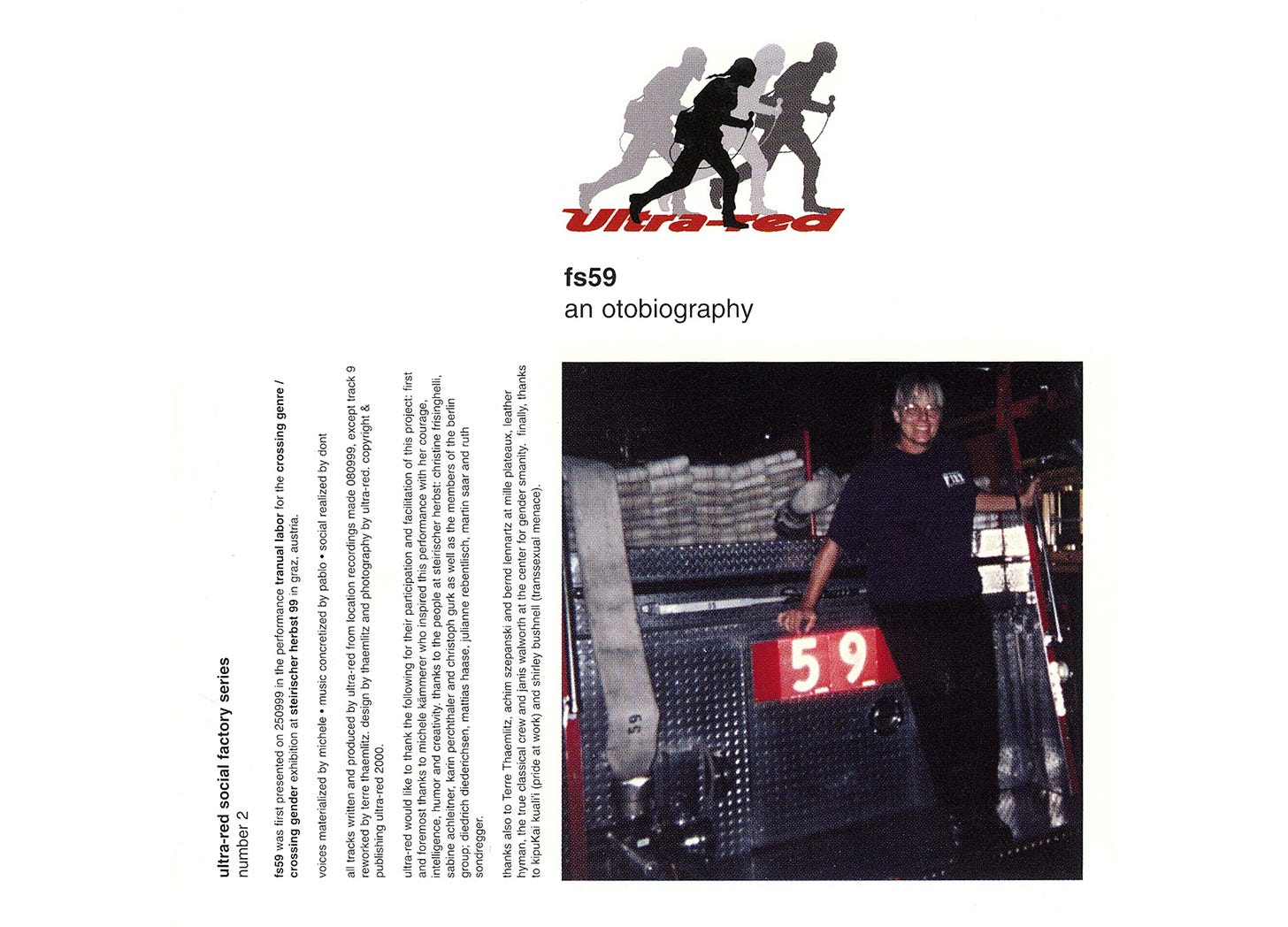
[Photo: Cover of Ultra-red, Fs59: An Otobiography (CD). Los Angeles: True Classical CDs, 2000. Artwork by Terre Thaemlitz.]
Fires have been very much on our minds this year. Soon out of the gate after the New Year, the City of Los Angeles was engulfed in smoke and falling ash from fires sweeping through the affluent seaside neighborhood of Pacific Palisades and the middle-to-working-class unincorporated area of Altadena. Other fires raged in the northern part of the county and, for one night, in the Hollywood Hills. The latter compelled yours truly to evacuate Hollywood for an unnerving night.
Images of the city shrouded in black smoke and a hellish sunset appeared across the mediascape. In a way, it was the image that would codify the constant volley of natural disasters that have become a daily occurrence in 2025. Floods, droughts, mudslides, record-breaking temperatures, and wildfires are so much part of our lives they rarely muster any response from policy-makers who, liberal to neofascist, have accepted the consequences of monopoly capitalism as a natural part of our world like capitalism itself.
And yet in each of these cataclysmic events, there are the immediate experiences of the people directly affected. Property destroyed, economies shattered, lives lost, landscapes ravished, and worlds unmade. While a hundred miles away life goes on. As long as some shred of normalcy remains, fire fighters will be deployed and first responders will react to crises.
I think about this when I revisit Ultra-red’s third album released twenty-five years ago. Earlier this year on May 21, we lost the remarkable Michele Kämmerer, the first transgender fire captain in the Los Angeles Fire Department. Michele was a devout Buddhist, an active supporter of liberal political causes, and one of the most down-to-earth and charming people you would ever have the honor to meet.
In 2000 Ultra-red released its third album of electroacoustic music, Fs59: An Otobiography (True Classical CDS). Pablo Garcia-Hernandez and I based the album entirely on interviews and site visits with Michele at Fire Station 59 where she was serving as captain at the time. Fs59 was the first album Pablo and I produced together, he having recently rejoined the band shortly before.
Pablo was part of the first incarnation of Ultra-red in 1994 when we were less a band than a sound-system and an after-hours chill-out club in Hollywood. Pablo left Marco Larsen and I shortly after we started the club, called Public Space. Years later, I would collaborate with him making music in early 2000 with the album Fs59 and the mini-album, La Economía Nueva (Operation Gatekeeper) released on FatCat Records in England in 2002.
With Fs59, Pablo and I hammered out a working method. We would build an archive of soundscape recordings and ethnographic interviews. Pablo would then process that archive using a variety of means ranging from digital audio software to analogue technologies like a beat up old Surge analogue synthesizer module unit.
With CD-R discs that Pablo loaded with rough sound experiments, I would then go about composing tracks from the original source material combined with the processed sounds and digital effects. While my earliest experiments in composition remained very much influenced by the tutelage I received from Marco, working with Pablo inspired me to pursue a radically different palette and syntax. The way Pablo and I worked together would go to shape the Ultra-red sound for the whole duration of our collaboration from 2000 to 2005. To my mind, our most accomplished works to come out of that method of collaboration were the releases Imperial Beach (Soundslike, 2003) and The Debt (Public Record, 2004).
Fs59 was also marked by a tentative articulation of a materialist sex and gender politics. Like most Ultra-red albums, Fs59 was informed by an engagement with a political movement context which, at that time, was the LGBT civil rights organization within the AFL-CIO, Pride At Work, of which I was an activist member. After having a political home in ACT UP Los Angeles and the harm reduction movement for the early part of the 1990s, Big Labor and its fealty to liberal politics resulted in constant cognitive dissonance. Like most mainstream LGBT organizations at the time, Pride At Work had adopted dominant assimilation politics sometimes pithily referred to as, “marriage and the military.”
Nonetheless, the temporary proximity to Big Labor afforded a context to engage first hand the problematics of class struggle within queer politics, first in the Sex Panic struggles of the late ‘90s (Second Nature, Mille Plateaux, 1999), and then in dialogue with the trans-liberation movement. For the latter, at least as it existed in Los Angeles, working-class trans-liberation politics were largely devoid of a radical political formation. An activist group like Transexual Menace followed the ACT UP and Queer Nation trajectory by adopting radical confrontational tactics while at the same time linking those tactics to otherwise mainstream demands about state protections and visibility within Lesbian and Gay spaces and institutions. The radical discourse gaining traction in academia and counter-cultural spaces at the time were often alienated from organized working-class trans politics.
Ultra-red’s brief collaboration with Michele Kämmerer was very much the product of these contradictions. The album performs its contradictions by pairing a radical musique concrète aesthetic (never purely acousmatic because of the ethnographic element in the compositions) with an interest in the materialist basis of actual existing trans-politics at the time. For that latter, less interested in a universalist claim to shattering the gender binary for the whole of society, the pragmatic demands of those materialist politics are noted in the album track titles lifted directly from the Transgender Bill of Rights. Here are the nine “Transsexual worker demands for transitioning on the job” as shown on the album sleeve, each demand was assigned a different rack on the album.
Company policy and union contracts must include nondiscrimination on the basis of gender identity and expression.
Swift action must be taken if harassment occurs.
Disclosure of gender difference to management must be kept confidential.
As soon as transitioning transsexuals begin to work in their new gender roles, they should be treated as members of that sex.
Reasonable use of restrooms and other sex-divided facilities, i.e. workers must have access to the facilities for the sex they are presenting in and those facilities should be convenient.
Employers must pay for adequate training for their coworkers.
Transsexuals should be included in the planning of how their transitions will be handled on the job.
Medical benefits through employers should cover treatment for gender identity disorder.
Management must take the lead in demonstrating respectful treatment of transsexuals and should be proactive in helping transition happen smoothly.
Reading these demands a quarter of a century later, a number of reflections struck me. The pragmatic nature of the demands resonate with the reality of people’s lives now as much as twenty-five years ago. In the years between 2000 and the present, it’s clear that as a result of agitation at various levels of society many of these demands established new forms of common sense with regards to the worker-employer contract. The extent to which that common sense was put into practice, however, was often determined by the level of liberal accommodation – something that was professionally and regionally uneven.
Nonetheless, it is now obvious that these demands articulate at a basic level how trans health and work-place accommodations underscore the class struggle at the center of what some on the Left have disparagingly referred to as, “identity politics.” Such a complaint was and remains a reinscription of puritanism within the Left polity, policing bodies and desires from a very narrow understanding of the working-class.
Given the global scale of the Right-wing mobilization, dismissing any historical materialist analysis of the struggles around trans health and human rights greatly diminishes our ability to wage class conflict in the current conjuncture. By refusing materials demands for life-affirming care, work-place safety, and human dignity for trans people, and by dismissing such as mere “identity politics,” puritanism on the Left attempts to erect walls around its own body politics. That refusal is nothing more than a resistance to any transformation of socialist definitions of embodiment, gender, and even sexuality. Today, the poison of trans-exclusive radical feminism (TERF) in the Left body politic has led to a demobilized and depoliticized socialist movement incapable of organizing mass resistance just as a neofascist movement completes its grip over both repressive (i.e., judicial, military, and police) and ideological state institutions.
The transphobic state project on the part of an openly fascist Right began while liberals were in power nationally. In the years before Trump returned to power in 2025, working-class people fled states like Florida where the neofascist movement succeeded in criminalizing publicly employed trans workers. Trans workers looked on in horror as Democrats made no bold move to counter the attack on workers. Mainstream LGBT foundations and human rights organizations remained silent. No LGBT organization called for the working-class to mobilize. And few national Leftist or liberal-left organizations sounded the alarm that workers were under attack in Florida. No strikes were called for and no walk outs threatened.
When large numbers of trans workers embarked upon a new Great Migration out of Florida, no national LGBT organization stepped in to support the sanctuary networks established to help refugees with housing and employment in other states. Instead, that sanctuary was entirely self-organized by small groups and social networks, often via WhatsApp and Signal. In general, for Leftists and liberals alike, the plight of trans workers was seen as particularistic and a matter of “identity politics.” And here we are today, with liberal superheroes like California Governor Gavin Newsom shoring up his bona fides as “the resistance” to the neofascists at the same time that he advances statewide attacks on trans rights (as well as attacking the unhoused – another consistent target of the liberal-neofascist nexus).
While none of what was to unfold over the following years was evident to Ultra-red in releasing the album Fs59 in 2000, the focus on class struggle as it intersects (and bifurcates) gender politics would prove prescient. In an attempt to further narrate a materialist class politics within trans liberation at the time, the same year Fs59 was released, Ultra-red partnered with socialist trans activist Masen Davis in writing the text, “Tranual Labor: Sound, the Body, and Labor” (published as “Tranual Labor: Sound, Körper, Arbeit,” in Golden Years: Materialien und Positionen zu Queerer Subkultur und Avantgarde Zwischen 1959 und 1974, ed. Diedrich Diederichsen, et al., Graz, Austria: Edition Camera Austria, 2006, pp. 57-67).
At the time, Masen was involved in Transexual Menace and would eventually go on to holding key positions in several lobbying organizations promoting transgender rights policies at the state, national and even international level. (Since our collaboration, Masen relocated to Berlin where he directs the NGO, Funders Concerned About AIDS). I first met Masen in the spring of 2000 participating in the organizing of anti-capitalist protests against the Democratic National Convention in Los Angeles in the lead up to the national elections that saw George W. Bush beat Democrat Al Gore for the presidency (recordings from those protests would eventually serve as the audio source material for the album, A Silence Broken (Public Record, 2006).
Reading the text “Tranual Labor” now, I’m struck by the profound influence materialist feminism would eventually have in shaping Ultra-red’s praxis. Even though Ultra-red’s sound investigation with the public housing defenders Union de Vecinos in the 1990s exemplified social reproduction praxis, in 2000 it was not yet clear how that praxis would translate into a materialist queer politics. In Fs59, and in the “Tranual Labor” project at large, I didn’t critically understand the implications of a labor aristocracy wholly dependent upon U.S. imperialism for its material conditions.
In the framework of social reproduction, class struggle and trans liberation (and the liberation of all subjects made “redundant” under neofascism) takes on a wholly different horizon in terms of praxis. Oriented towards that horizon, praxis becomes all the more acute in this moment with state assaults on trans life, including the liberal retreat from human rights. The same can be said of the autonomy of migration, sex worker rights, the autonomy of the unhoused, and the bare life of every other social group targeted by the neofascist assault on the lumpen.
To be clear, this doesn’t mean that labor struggles, including the labor of trans workers, are no longer relevant to liberatory politics. But given the genocidal imagination that has taken hold of liberal and reactionary institutions alike, collective survival is a more fundamental struggle than state labor protections. It’s also a new terrain given that the primary engine driving capitalism is itself warding off the existential threat engulfing its very contradictions. Trans militants have much to say about embodying the world after capitalism, and before the fires take us all.
Here’s a short documentary produced by UCLA about Michele Kämmerer.
https://bellinghamalive.com/lifestyle/wonder-women-michele-kammerer-janis-walworth